Toll Dry Granulation by Roll Compaction
Roll compaction that transforms dusty, low-density powders into uniform, free-flowing granules ready for downstream handling.
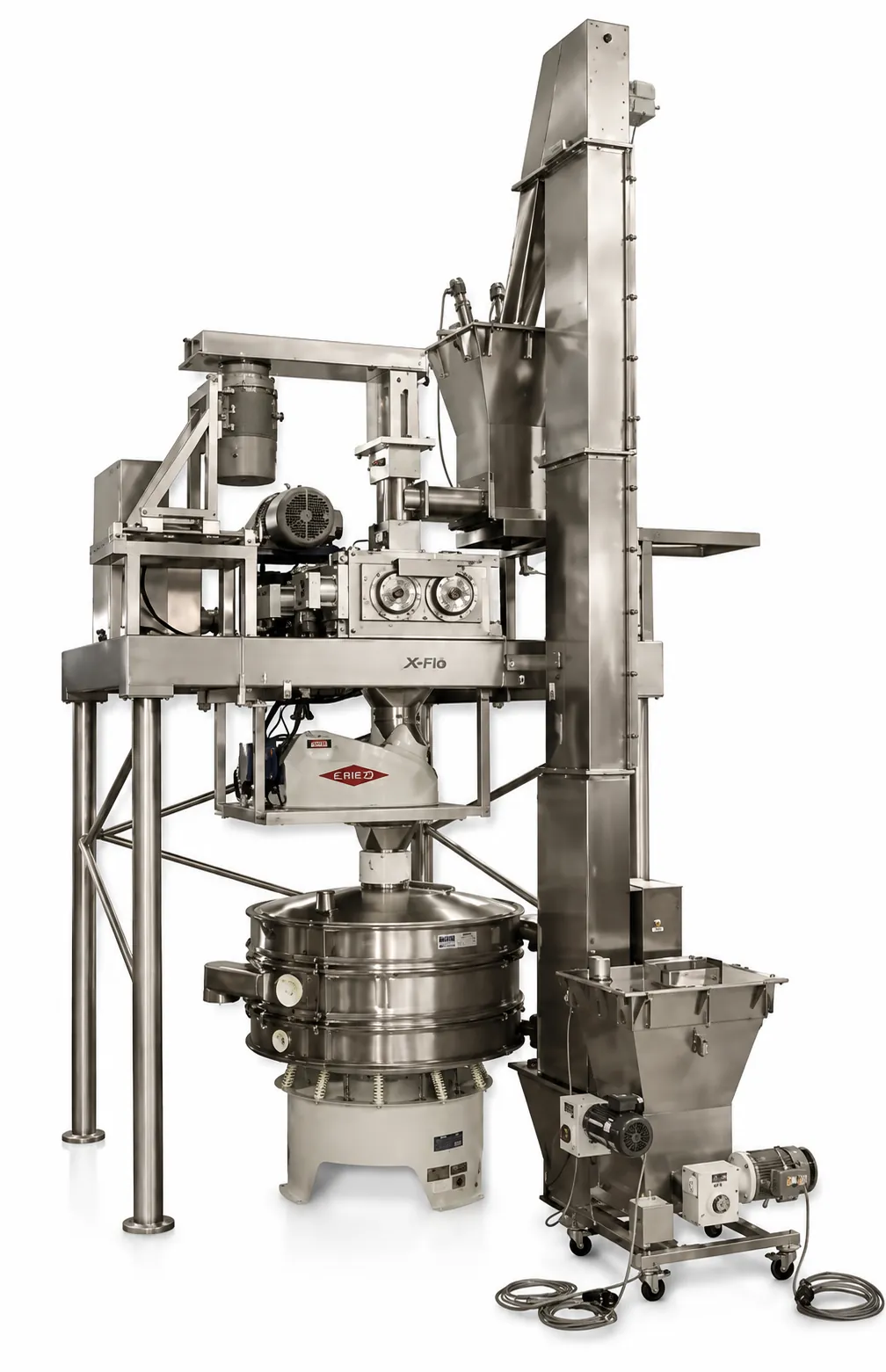
D&A Granulation provides toll dry granulation by roll compaction in Lakewood, NJ: you ship us a dusty or non-flowing powder, we compact and size it into free-flowing granules to your spec, and ship it back.
What dry granulation does for your material
Non-flowing, dusty, low-bulk-density powders create real problems on a production line. They clog feeders, segregate in transit, and dust the workplace. Dry granulation solves that. The roll compaction process compresses the powder into a uniform particle size, raising bulk density and giving you a free-flowing, dust-free product that handles, blends, and meters cleanly.
A granular form also absorbs liquids more readily than most powders, so downstream dispersion and dissolution happen faster.
Materials and industries we granulate for
Roll compaction suits dry powders that need to flow, meter or dissolve better without adding water or heat. Typical applications:
- Specialty plastics additives - UV absorbers, light stabilizers, antioxidants and other additives that need a dust-free, free-flowing form for compounding lines. See plastics additives.
- Vitamins and minerals - mineral salts and nutritional ingredients densified for tableting, blending or capsule filling. See nutritionals and pharmaceuticals.
- Food ingredients - sugars, salts and other dry ingredients that cake, dust or segregate as fine powders. See food ingredients.
- Water treatment chemicals - dry industrial and wastewater treatment chemicals, where granules handle more cleanly and dose more consistently. See water treatment chemicals.
- Pharmaceutical intermediates and specialty chemicals - moisture- or heat-sensitive powders where wet granulation isn't an option.
Not sure your material will compact? Send us a description and we'll tell you whether a trial run makes sense.
Why customers choose D&A for roll compaction and granulation
- 30 years of experience with over a thousand different formulations across chemicals, foods, nutritionals, and pharmaceuticals.
- Seven processing rooms in a 20,000 sq ft plant, three of them dedicated to food and nutritional work, separate from the chemical rooms. Dust collection runs during processing.
- Particle size distribution checked against your spec, with every lot tracked. See quality and certifications.
- ISO 9001:2015 certified and FDA registered.
- A team that has processed 1,000+ materials since 1996, across every category on the floor.
Weighing dry against wet granulation? Our guide compares the two: roll compaction vs. wet granulation.
Frequently asked questions
What is dry granulation by roll compaction?
Powder is fed between two rolls that press it into a dense sheet or briquette, which is then milled and screened into granules of a target size. No water or binder is added, which makes it a good fit for moisture- or heat-sensitive materials.
What problems does it solve?
Dusty, low-density or non-flowing powders that clog feeders, segregate in blends or dust the plant. Granules flow, meter and blend more consistently.
What's the minimum batch size?
Around 750 lbs for dry granulation. Milling, screening and repackaging jobs can start lower, at around 500 lbs.
How to start
Send a description of your material and the batch volume. We'll come back with feasibility, a process recommendation, and a quote. Email contact@dandagranulation.com or call 732-994-7480.
Have a powder that won't flow?
Tell us about it. You'll get an honest read on whether granulation is the right fix.
Send us the material. We’ll run it.
Send the form and we'll reply within one business day with next steps and trial-run options.